A Walk Through Time: The Fascinating History and Evolution of Barefoot Shoes and Minimalist Footwear

Barefoot shoes are not a 2005 invention. For most of human history the basic shoe was a flat sole and something to hold it on, and people built up from that only when the cold or the ground made them. The strange shoe is the modern one: the cushioned, heel-raised trainer, which is about fifty years old. What follows is the actual route from woven bark sandals to a paper in Nature and a class action lawsuit.
The oldest shoes we still have
The oldest surviving footwear in the world is a pile of sandals woven from sagebrush bark, found in Fort Rock Cave in Oregon and radiocarbon dated to somewhere around 10,000 years old. They are flat, plant fibre, and about as minimal as a shoe can get while still being a shoe.
The oldest known leather shoe is younger and better preserved. It came out of the Areni-1 cave in Armenia in 2008, dates to roughly 3500 BC, and is a single piece of leather, probably cowhide, wrapped around the foot and drawn closed with a thong through the front and the back. It is a moccasin in everything but name, made 5,500 years ago.
One honest caveat before the rest of this page, because barefoot sites tend to skip it. Thin was not a principle, it was a consequence of what was available. When conditions demanded otherwise, people built up. Otzi, the man who died in the Alps around 3300 BC, was wearing bearskin soles and deerskin uppers over a bark string net, stuffed with grass for insulation. That is not a minimalist shoe. That is a boot.
Egyptian sandals

Ancient Egyptians made sandals from papyrus and palm leaf, and later from leather. The construction is open and flat, which is exactly what you want in dry heat. What the usual telling of this story leaves out is that Egyptians were mostly barefoot. Sandals were occasional, and often a marker of rank rather than daily equipment. Tutankhamun was buried with dozens of pairs. Most people had none.
Greek and Roman sandals

The everyday Greek sandal was the sandalion, a sole of leather, cork or wood held on by a toe thong and an ankle strap. The word you often see attached to that description, krepis, is the wrong one. A krepis was a thicker soled sandal boot with a latticed upper, sometimes hobnailed, and it was closer to military kit than to a summer sandal.
Rome had the same split. The solea was thin and indoor, the sandal you changed into at dinner. The shoes that did the walking were the calceus, a closed citizen shoe, and the caliga, the hobnailed military sandal boot that carried a legion twenty miles a day. So Rome is not evidence that everyone wore minimal footwear. Rome is evidence that people picked thin or thick depending on what they were about to do, which is still the right answer.
Huaraches, and the cattle problem

Almost every article about huaraches says they are woven cowhide sandals dating to pre-Columbian Mexico. That specific pairing does not work. There were no cattle in Mesoamerica until the Spanish brought them, so the woven cowhide version has to be post contact. The pre-Columbian sandal, cactli in Nahuatl, was made from what was already there: plant fibre, and hide from animals that were.
What is genuinely continuous is the shape and the idea: a flat sole, tied on, nothing under the heel. The Raramuri of the Copper Canyons still run in that pattern, and for decades the soles have often been cut from worn out car tyres. That sandal is where a good part of the modern barefoot industry got its idea, and it matters later on this page.
Shoes made from whatever was to hand
Native American moccasins

A moccasin is soft hide, usually deer, cut in one piece and gathered around the foot with an optional vamp across the top. Plains versions often added a rawhide sole, which is stiffer, because the ground there is harder. The beadwork was identity, not decoration for its own sake, and the pattern told you which people the wearer belonged to.
Worth saying plainly: moccasins are not waterproof and were not worn year round. In warm, wet months a lot of people simply went barefoot.
Sandals cut from tyres

This is the photograph on this page that is closest to the point of the whole site. The sole is a piece of a dead tyre. The straps are cut from the same carcass. The materials cost nothing, the sole is completely flat, and it bends anywhere you ask it to. Tyre sandals are made and worn in many parts of Africa, and the same trick shows up wherever tyres pile up and money does not.
Aboriginal Australia, where the answer was mostly nothing

Across most of Aboriginal Australia the answer was bare feet, over terrain that would stop most people reading this inside a hundred metres. Practice varied by region, but there is no single everyday sandal to catalogue, and an article that hands you one is filling a gap in a table.
The one well documented specialised shoe is the kurdaitcha, known in Arrernte as kwertatye: a sole of matted emu feathers with a human hair upper. Early European accounts said blood was the binder, though the matting alone may account for it. It was ritual footwear worn by a man carrying out a sanctioned killing, and the point of it was to leave no trackable print. It is a remarkable object and it is not gear for a long walk.
Traditional Asian footwear
Japanese zori, geta and waraji

Zori are flat thonged sandals of rice straw or other fibre, worn with kimono. Geta are the wooden ones on two raised teeth, which lift you clear of mud and are now mostly informal, worn with yukata. Waraji are the straw sandals that did the actual mileage: commoners, travellers, monks, foot soldiers.
Waraji are the interesting ones, and not because they were comfortable. A pair lasted about three or four days of hard walking, which is why Edo period travellers carried spares slung off their pack. Minimal footwear has always had a running cost. It just used to be paid in straw.
Chinese cloth shoes

The embroidered cloth shoe with a thin layered sole is a real and long lived Chinese form, and it is genuinely flexible in a way most modern shoes are not. One correction to the usual line, though: the everyday ancient Chinese shoe was straw or plant fibre, and cotton only became a common cloth much later. Silk uppers were for people who did not walk far.
Indian paduka

A paduka is a sole with a post and a knob that you grip between the first and second toe. Wood, sometimes ivory or silver. Worn by Hindu, Buddhist and Jain ascetics, and in far more ornate versions at weddings and courts.
It belongs on this page for honesty rather than as an ancestor. A paduka is rigid, it has a raised platform, and you hold it on with a toe grip. By every criterion this site uses, it is the opposite of a barefoot shoe. It is also not the traditional footwear of India, just one old form among many.
The modern barefoot shoe movement
Most of the footwear above was thin because of what it was made from and what it was for, and some of it, like Otzi’s boots and the paduka, was not thin at all. The modern category is different: it is minimal on purpose, sold as a corrective to the cushioned trainer. That industry has an origin story it likes to tell, and a second half it tells less often.
Vibram FiveFingers

The shoe that started the modern era was not designed for runners. Robert Fliri, a design student from the Vinschgau, wanted something you could wear to move properly over rough ground. Several manufacturers turned him down. Vibram took it in 2005 and initially sold it as deck footwear for sailing, because a glove for your foot makes obvious sense on a wet boat.
Runners found it anyway, and the toe pockets made it impossible to mistake for anything else. It is also the reason a lot of people still think barefoot shoes means toe shoes, which has been wrong for about fifteen years.
The modern era
How barefoot shoes went mainstream, and then did not
| Year | What happened |
|---|---|
| 2005 | A design student, Robert Fliri, pitches a five toed shoe to Vibram after other makers turn him down. The FiveFingers ships that year, aimed at boat decks rather than runners. |
| 2009 | Christopher McDougall publishes Born to Run and sells over three million copies. Xero Shoes is founded in Boulder the same year, selling kits to build your own huaraches. |
| 2010 | Daniel Lieberman’s team publishes in Nature: runners raised barefoot tend to land on the forefoot, while cushioned heels make a heel strike easy. Vibram part funded the work. |
| 2012 | Peak minimalism. Almost every large running brand ships something it calls barefoot or natural. |
| 2014 | Vibram agrees to pay 3.75 million dollars to settle a class action over the health claims it made for FiveFingers, admitting no liability, and to stop making those claims unless it has evidence to back them. The shoe itself stays on sale. Hoka, founded in 2009 on the opposite idea, is already owned by Deckers. |
| Now | The category survives, but as everyday shoes rather than a running revolution. That is a smaller claim and a more honest one. |
What the boom actually left behind
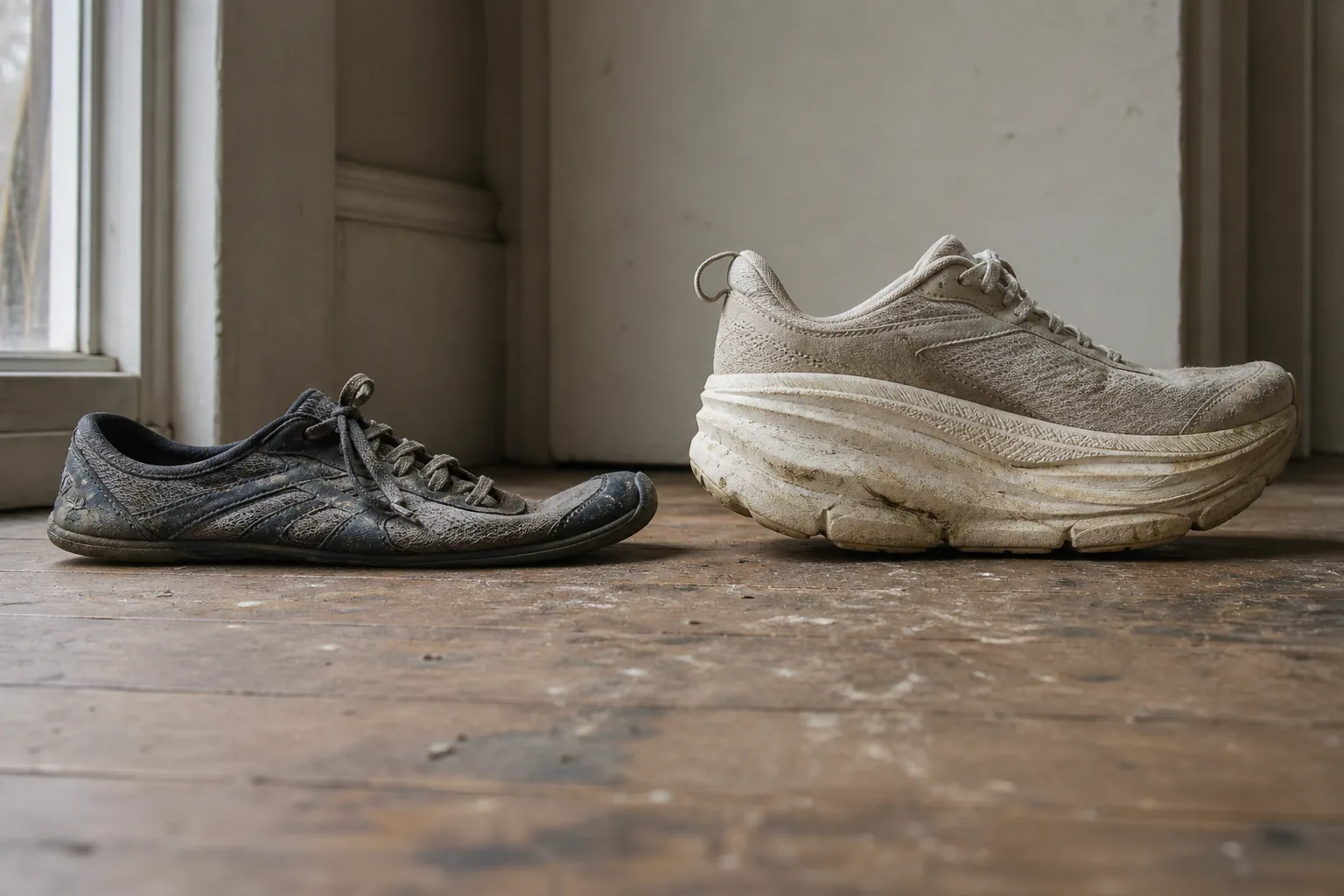
Here is the part that gets left out of most barefoot shoe history. The minimalist boom did not win. It peaked around 2012, took a legal and reputational hit in 2014, and the mass market went the other way entirely, into the thickest foam midsoles ever sold. The two shoes above are from the same decade.
That is worth sitting with if you are about to buy your first pair. The evidence that a thin, flat, wide shoe lets your foot work the way it is built to is decent. The claim that it will fix your knees, make you faster or prevent injury was oversold, and it cost Vibram 3.75 million dollars to stop advertising it. What survived the correction is the useful bit: shoes shaped like feet, with nothing under the heel, worn by people who wanted their feet to do more.
The brands that came out of it

Xero Shoes began in 2009 in Boulder, selling do it yourself huarache kits under the name Invisible Shoes, straight off the back of Born to Run. That is a direct line from a Raramuri sandal to a shoe you can buy today. Vivobarefoot came the other way round. It started in 2004 as a line inside Terra Plana, a British shoe company already going since the nineties, and the parent only took the Vivobarefoot name itself in 2015.
Merrell gets listed alongside those two constantly, and it does not belong there. Merrell is a 1981 hiking boot brand that added a minimal line when the category got hot. Good shoes, wrong shelf. The distinction matters when you are working out whose sizing and shape to trust, because a specialist has been solving foot shaped lasts for a decade and a big brand has been solving it for one product range.
What all of them are chasing is the thing the tyre sandal already had: ground feel. That is partly touch, through the sole, and partly proprioception, your sense of where your own joints are. A thick sole is not neutral. It sits between you and both of them.
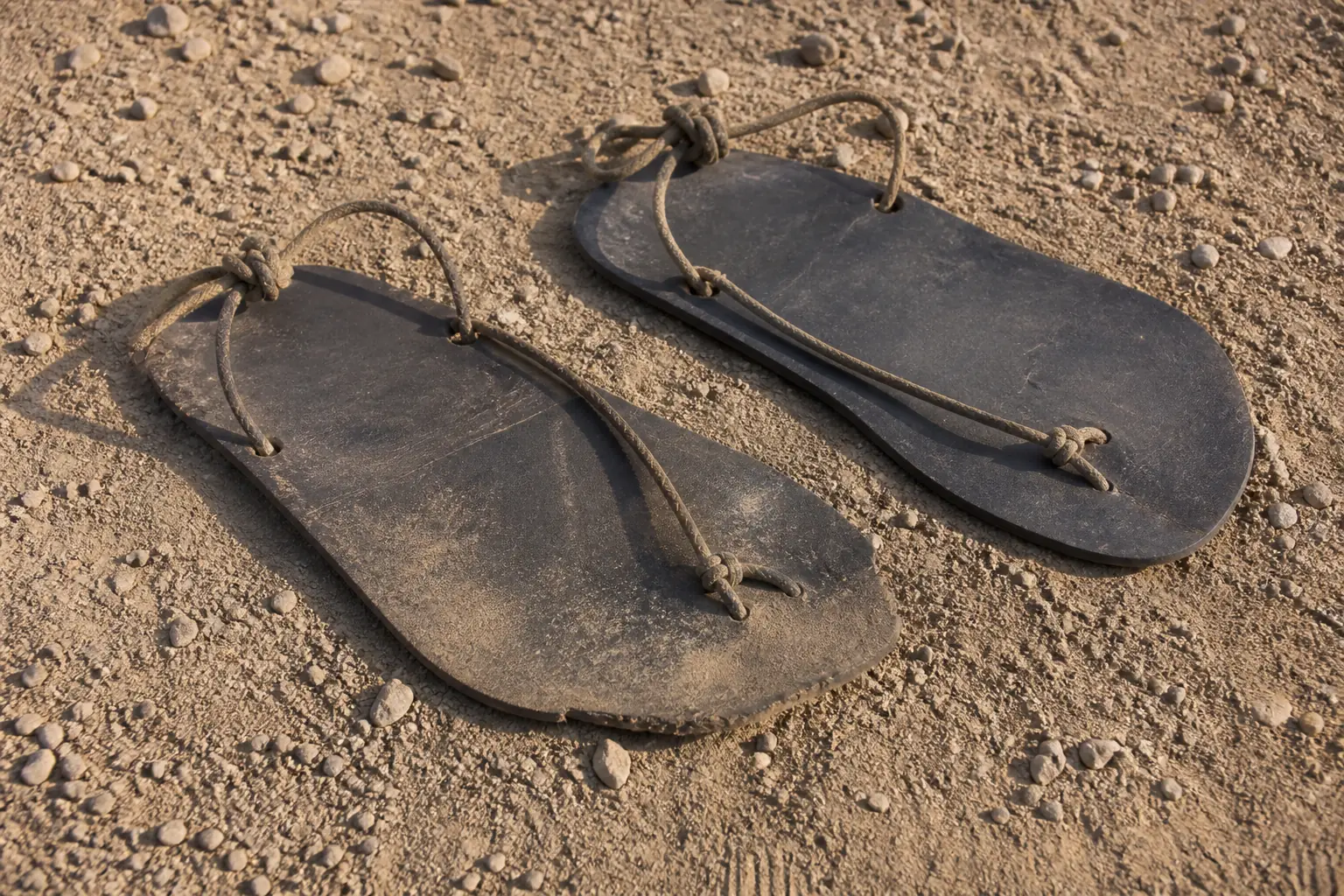
Which is why the oldest pattern on this page is still the one that answers the question most directly. A flat sole and something to tie it on with. The material has gone from bark to hide to a slice of radial tyre, and for the specific job of protecting a foot without muffling it, nothing since has done much better.
What this history is good for
Mostly as a corrective to the marketing. Barefoot shoes are not a breakthrough and they are not a fad. They are close to the oldest and plainest thing you can put on a foot, and the mass market spent about five decades walking away from it. Coming back is a fairly modest thing to do. It also takes time, because feet that have been held in a cushioned heel for thirty years are not ready for a tyre sandal on Monday.
If you want the practical version rather than the historical one, start with our guide to minimalist shoes, or work through the rest of baretread.com for what we have actually put on our feet.
Sources
Where the specific claims on this page come from, so you can check them rather than take our word for it.
- Fort Rock Cave, Oregon. The sagebrush bark sandals, radiocarbon dated to between about 9,200 and 10,200 years old. Thomas J. Connolly, Oregon Encyclopedia, and the Great Basin sandal collection at the Museum of Natural and Cultural History, University of Oregon.
- Areni-1, Armenia. The excavation report on the oldest known leather shoe. Pinhasi et al., PLOS ONE, 2010.
- Otzi’s clothing, including the insulated bearskin and deerskin shoes. South Tyrol Museum of Archaeology.
- Roman footwear. Over 6,000 leather shoes have come out of the waterlogged deposits at one fort on Hadrian’s Wall. the Vindolanda Trust leather project.
- Paduka. A catalogued pair of toe knob sandals. Philadelphia Museum of Art.
- The kurdaitcha shoe. The early European account this page refers to, which is also the source of the claim about blood as a binder. Spencer and Gillen, The Native Tribes of Central Australia, 1899.
- Barefoot running mechanics. The 2010 paper, part funded by Vibram. Lieberman et al., Nature.
- The FiveFingers class action. Complaint, settlement terms and the health claims at issue. Truth in Advertising.