Best Barefoot School Shoes for UK Children
For most UK schools the decision is made by the uniform policy before it is made by anything about feet. If the policy says plain black shoes, your barefoot options shrink to black, flexible shoes that read as shoes rather than trainers. If it tolerates black trainers, everything below is in play. This page works through the school test first, then the weather, then fit, and finishes with the pairs that pass all three.
Which barefoot shoes work as school shoes?
Three survive the check I would apply before buying for a UK school: the Xero Prio Kids for everyday wear and PE, the Wildling Chestnut for cold dry days, and the Vivobarefoot Primus Kids for the warm months. Every one was in stock and buyable from the UK when I checked in August 2026. Two pairs the older version of this page recommended failed that check, one because it is made to order in the USA and one because its own shipping page would not confirm it ships here, so they are gone.
At primary age, brand matters less than three properties: a toe box that is wide, a sole that bends, and a fastening your child can work alone. If a shoe has those and passes the uniform check, it is doing the job. The health claims some shops make for these shoes are louder than the evidence, which I come back to at the end.
Does your school allow them?
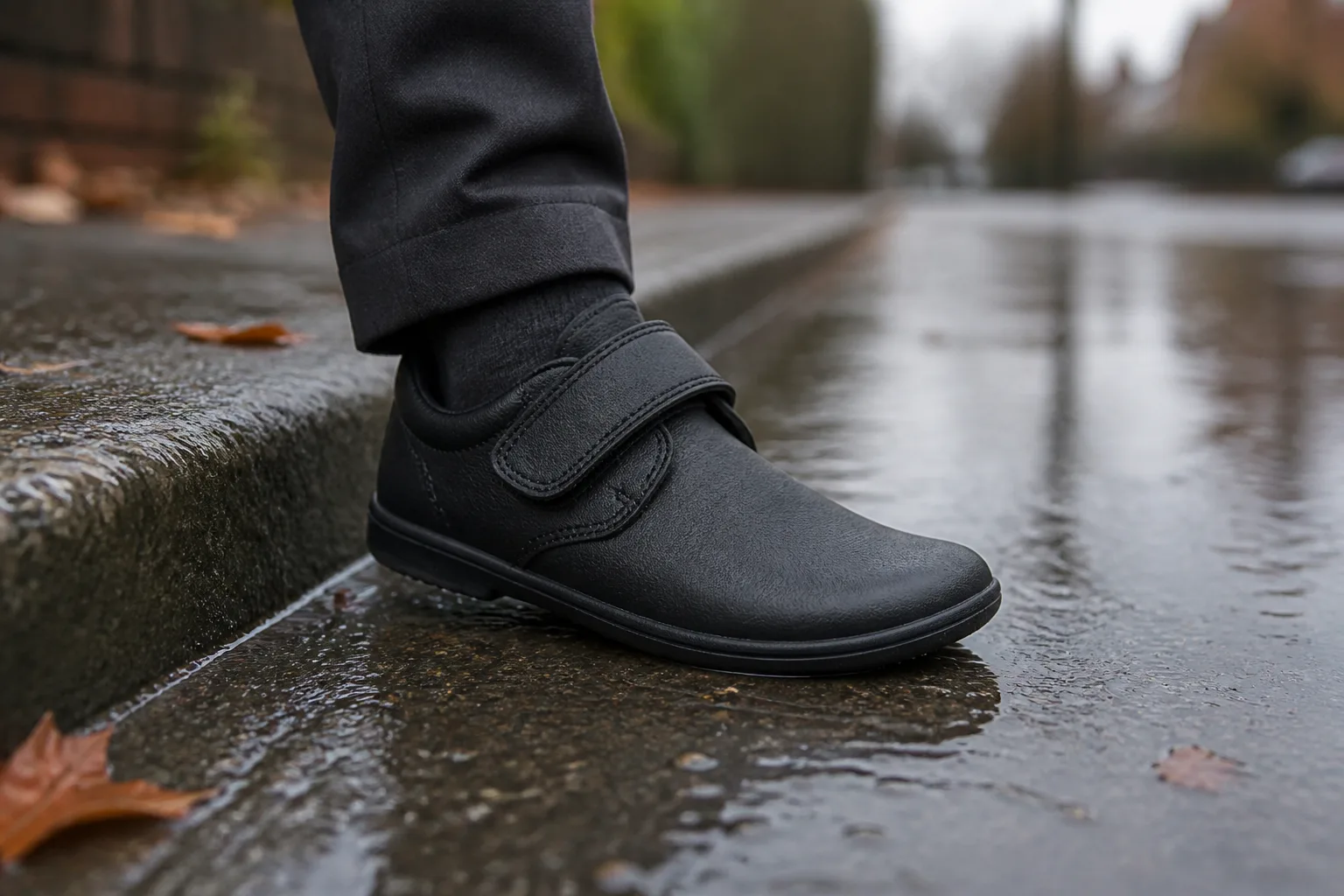
Read the actual policy, not a parents’ group’s memory of it. The details that decide it: whether the wording says shoes or trainers, whether it demands black, whether it bans logos, and whether the sole has to be black too. A flexible black shoe is a different object from a coloured trainer, and that distinction is usually what gets a shoe approved or sent home.
If your school is strict and none of the barefoot options pass, the split approach works: a conventional black shoe on uniform days, barefoot trainers on PE days and weekends. Children spend most of their running-around hours out of school anyway.
What about wet weather?
The UK school run from September to April is the hardest test here. Mesh uppers, which most breathable barefoot trainers use, soak through in minutes. Wool insulates well but absorbs water. Leather or synthetic leather holds up best. None of these are waterproof boots: on genuinely wet days the answer is wellies or waterproof shoes, same as it ever was. Buy the everyday pair in the darkest colour you can, because wet playgrounds show on light mesh within a week.
How should barefoot school shoes fit?
Measure both feet with your child standing, and fit the longer one. Aim for 10 to 12mm between the longest toe and the inside end of the shoe, unless the brand publishes its own fitting allowance. The reliable way to check is to pull the insole out and stand your child on it, or measure against the brand’s published internal length. Pressing a thumb through the upper is a fallback, not the method: a child who feels pressure curls their toes away from it.
Width and volume matter as much as length. If the upper bulges over the sole at the sides, or a strap runs out of adjustment before the shoe is snug, the volume is wrong. Expect to replace on growth rather than wear; that is the real running cost of kids’ shoes of any type. Xero has a separate sizing page for its range, and brands differ on whether they quote UK or EU sizes, so check before ordering.
The three worth a look
Xero Prio Kids: the default for school and PE

The Prio is the closest thing this category has to a default. Xero splits it into Prio Little Kids and Prio Big Kids: little kids colourways were £31.50 to £45 when I checked, big kids £50, with the black and white pair in stock. The sole is zero drop with a 7.5mm total stack height, so it bends easily but survives playground abuse better than thinner soles. Instep and midfoot tension straps let most children tighten them without help, which matters more than it sounds at five past nine in the classroom line. Synthetics wipe clean.
Wildling Chestnut: cold, dry days

This is the shoe the older version of this page called the Marone; Wildling now lists it as Chestnut. A mid-cut wool and hemp shoe with a wool lining, made in kids sizes EU 23 to 34, most of them in stock at 99 EUR when I checked. On dry freezing mornings it is the warmest thing here by a distance. The tradeoff is rain: wool soaks up water and dries slowly, so this is a cold-dry-days shoe, not a wet-weather one. Wildling ships from Germany, so check the delivery estimate and any customs charges at checkout before ordering.
Vivobarefoot Primus Kids: warm months

Vivobarefoot’s Primus line is the breathable option, currently sold in the UK as the Primus Sport IV Kids. A thin, flexible sole and a mesh upper that keeps feet cool through the summer term. That same mesh fails the wet weather test above, so treat this as the warm-months pick rather than an all-year shoe. Vivo is a UK company shipping domestically, which makes it the lowest-friction order here.
Quick comparison
Compare at a glance
| Shoe | Best for | Watch out for | Price checked Aug 2026 |
|---|---|---|---|
| Xero Prio Kids | Everyday wear and PE | Not waterproof | £31.50 to £50 |
| Wildling Chestnut | Cold dry days | Wool soaks; ships from Germany | 99 EUR |
| Vivobarefoot Primus Kids | Warm months | Mesh lets rain in | Check current UK listing |
Questions parents ask
What about older or bigger kids?
Xero splits its kids range into Little Kids and Big Kids, Wildling’s kids line runs to EU 34, and Vivobarefoot sells junior sizes of several models. Past those sizes the answer is the smallest adult size that fits, checked the same way: insole out, stand on it, 10 to 12mm.
Are there vegan options?
Yes. The Prio is synthetic, the Primus is mesh and synthetic, and both are vegan. The Chestnut is wool and hemp, so it is not.
My child has high or low volume feet. Does that matter?
Volume is width plus instep height, and two shoes the same length can fit very differently. The signs are practical: an upper that tents over the laces or straps that run out of travel means the volume is too low, a foot that slides side to side in a correctly sized length means it is too high. If a brand offers a volume or width note on its size chart, use it; if not, order from somewhere with returns.
What is the cheapest way to try this?
Sale colourways. The Prio Little Kids dropped to £31.50 in some colours when I checked, against £50 for the current big kids range. Expect to buy twice a year at primary age regardless of brand, so the honest budget line is the price of the shoe times two, not the price of the shoe.
A note on the health claims you will meet elsewhere: good research shows footwear changes how children walk, and toe space plus a sole that bends are sensible things to want in a shoe. The louder claims about posture, development and injury prevention are not settled, and recent reviews of children’s footwear guidance say plainly that much of it rests on expert opinion rather than trials. See the 2025 review of children’s footwear guidelines and the 2023 review of footwear and gait. Most childhood flat feet resolve on their own; the NHS says when to get feet checked. Prices and stock in this post were checked on 27 August 2026 at the merchants’ own shops and will change. For the wider picture, start with barefoot shoes for kids or the UK brands guide.