Are Barefoot Shoes Good for Running?

Yes for most healthy runners, and no in the way most people try it. A barefoot running shoe does not make running safer by itself. It moves the work. A thin, zero-drop sole pushes you off your heel and onto your midfoot, which takes load out of your knees and puts it into your calves, Achilles and feet. If those are ready, you end up a stronger runner. If they are not, you get the injury list halfway down this page.
Which means the shoe is not really the decision. The transition is. Buy the shoe, keep your old mileage, and you will hurt yourself in a new place.
What counts as a barefoot running shoe
Four things, and a shoe needs all four to qualify. A sole thin and flexible enough to feel the ground through. A toe box wide enough for your toes to splay when you land on them. No height difference between heel and toe, which is what zero drop means. And almost no cushioning, so your foot and lower leg absorb the landing instead of the foam.

What you get out of them
The whole case rests on the strike pattern. Landing on the middle or front of the foot instead of the heel spreads impact through the arch and calf rather than sending it up the leg, and it usually arrives with a shorter stride and a quicker turnover, which lowers the force of every landing. The small muscles in your feet and lower legs finally have to work, so they get stronger. Ground feel improves, so you adapt your stride to the surface without deciding to.
“Running barefoot or in minimalist shoes is like strength training for your feet.”
Dr Irene Davis, Harvard Medical School
There is an efficiency argument on top. A 2022 study in the journal Sensors found the foot’s core muscles and arch add recoil energy during the stance phase, while runners in shoes bounced up and down more, wasting energy. Read that finding carefully though. It measured running barefoot, not running in barefoot shoes. The shoe is standing in for the bare foot, and nobody has shown the two are the same.
What it costs you
Tendons adapt more slowly than enthusiasm. The calf and Achilles work a zero-drop sole demands takes weeks to months to build, and the standard failures inside that window are stress fractures, Achilles tendonitis and plantar fasciitis. Those are three of the injuries the benefits list is supposed to help you avoid, which tells you how much the transition matters and how little the shoe does on its own.
The rest is simpler. Minimal cushioning means minimal protection, so sharp gravel and hard ground both register. And some feet, some gaits and some existing conditions do not suit these shoes at all, which is a conversation for a physio rather than a blog post.
What the research actually says
Mixed, and the mix is the useful part. The strongest finding against a casual switch comes from Oregon State University Cascades, which looked at young runners and found the loading rates linked to stress fractures and plantar fasciitis more than doubled running barefoot and nearly doubled in minimal shoes, measured against traditional ones. That is not a reason never to do it. It is a reason never to do it abruptly, and a reason to be more careful with a teenager than with yourself.
The number quoted most often in favour is that 69% of people who switched reported better performance, many of them alongside fewer recurring injuries. Check where it comes from before you lean on it. The source cited at the bottom of this page is a survey of 65 people written up on a personal blog, not a controlled trial, and people who chose to switch and then filled in a survey about it are exactly the group you would expect to report success. It is worth something. It is not worth what a journal citation would be.
The form change is the actual product
You can buy the shoe and change nothing, in which case you have bought a shoe with no cushioning to carry on heel striking in. That removes the protection without adding the technique, and it is the single most common way this goes wrong.
The change is five things. Land on your midfoot or forefoot. Lift your cadence towards 180 steps a minute so the strides get shorter and quicker. Keep your torso upright with your core engaged. Shorten your stride until your foot lands under your centre of mass instead of out in front of it. And keep the footfall soft. Noise is the easiest of the five to check on yourself: a loud slap usually means you are still reaching ahead of your body.
“The Shoes That Fix Bad Running Technique”, from the Barefoot Strength channel.
How to switch without hurting yourself
Transition plan
Six weeks of doing less than you want to
Run 10 to 15 minutes, no further
That is the whole first run, however good you feel at the end of it. Build the duration over several weeks rather than several days.
Judge the run on form, not distance
Midfoot landing, quick cadence, quiet feet. If the form goes, the run is over, even if the legs have more in them.
Strengthen your feet off the road
Toe curls, calf raises and balance drills on the days you are not running. This is the part that decides whether the transition works.
Leave real recovery between runs
The adaptation happens on the rest days. Back-to-back runs in the first weeks are how the calf and Achilles problems start.
Stop at pain, not after it
Soreness in the calves is expected. Sharp pain in the heel, the arch or the Achilles is not, and running through it turns a week off into a season off.
Get someone to watch you run
A coach or a physio who has worked with minimalist runners will spot an overstride in about thirty seconds. You will not spot it yourself.
Two shoes people usually start in
Xero Shoes and Vivobarefoot are the two brands with a proper barefoot running range, and these are the models most people land on first.
Vivobarefoot Primus Lite
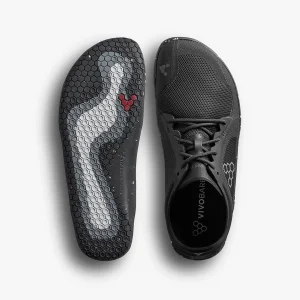
An ultra-thin puncture-resistant sole under a breathable mesh upper made from recycled materials, with a wide toe box and very little weight to it. Light and flexible is the whole design brief.
Xero Shoes HFS II
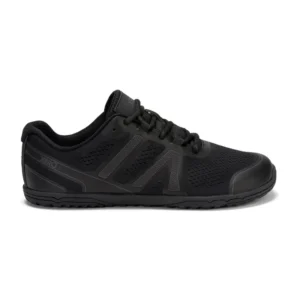
A 9mm sole that includes a thin BareFoam layer wrapped up around the upper, so it looks chunkier than it is, over a removable 3.5mm insole. Zero drop, wide toe box, laced like an ordinary trainer. Vegan materials throughout, if that decides things for you.
Who should think twice
Before you buy
Where you are starting from
Frequently asked questions
Can anyone start running in barefoot shoes?
Most healthy runners can, given a slow enough transition. Existing foot conditions and biomechanical problems are the exception, and those are worth a professional opinion rather than a guess.
How long does the transition take?
Several weeks to a few months, depending on how much running you already do and how patient you are. The limit is tendon adaptation, and tendons do not hurry.
Do barefoot shoes prevent injuries?
They change which injuries you are exposed to. Knee pain can improve if the strike pattern changes with them. Stress fractures and Achilles problems get more likely if you switch too fast.
Can I use barefoot shoes for trail running?
Yes, but on a trail-specific model. Those keep the flexibility and add a little more protection underfoot, which matters once the ground has rocks in it.
Is there a halfway option?
Transitional minimalist shoes. They keep some cushioning and support while still nudging you towards a more natural stride, which suits anyone who wants the form change without losing all the protection at once.
References
- Barefoot Shoes Transition Study (the 65-person survey behind the 69% figure)
- Barefoot and Minimal Shoes May Increase Injury Risk in Young Runners
- New Study Finds Running Barefoot is More Efficient Than Running With Shoes
- Effects of Highly Cushioned Shoes on Running Performance
- Foot Strike Patterns and Injury Rates in Runners


I know this if off topic but I’m looking into starting my own weblog and was curious what all is required to get set up? I’m assuming having a blog like yours would cost a pretty penny? I’m not very internet smart so I’m not 100 positive. Any tips or advice would be greatly appreciated. Cheers
I’ve been exploring for a little bit for any high quality articles or weblog posts on this kind of house . Exploring in Yahoo I ultimately stumbled upon this website. Studying this info So i am happy to exhibit that I have a very just right uncanny feeling I came upon exactly what I needed. I such a lot indisputably will make sure to do not forget this website and provides it a glance on a continuing basis.
hey there and thanks in your information – I have definitely picked up anything new from right here. I did then again experience some technical points the usage of this web site, since I skilled to reload the web site lots of instances previous to I may just get it to load properly. I have been pondering in case your hosting is OK? Not that I’m complaining, but slow loading cases times will often impact your placement in google and can harm your high quality rating if ads and ***********|advertising|advertising|advertising and *********** with Adwords. Well I’m adding this RSS to my email and could glance out for a lot more of your respective fascinating content. Make sure you update this once more very soon..
Hi, just required you to know I he added your site to my Google bookmarks due to your layout. But seriously, I believe your internet site has 1 in the freshest theme I??ve came across. It extremely helps make reading your blog significantly easier.